The Folded Napkin


John 20:6-9 – Then Simon Peter, who had been following him, arrived and went right into the tomb.  He saw the strips of linen cloth lying there, and the face cloth, which had been around Jesus’ head, not lying with the strips of linen cloth but rolled up in a place by itself.  Then the other disciple, who had reached the tomb first, came in, and he saw and believed.  (For they did not yet understand the scripture that Jesus must rise from the dead.)”

As I read, prayed, and pondered the Word of God today, several things moved me and captured my thoughts.  The folded napkin in the tomb is meaningless in our Western culture, but not in Jewish culture.

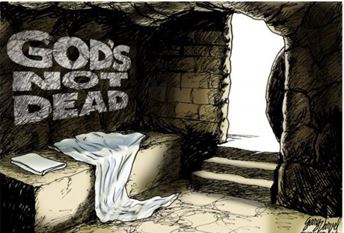
The Gospel of John 20:7 tells us that the napkin, which was placed over Jesus’ face, was not thrown aside like the other grave clothes.  The Bible takes an entire verse to tell us that the napkin was neatly folded and was placed at the head of that stony coffin.

Simon Peter arrived and went inside.  He also noticed the linen wrappings lying there, along with the cloth that had covered Jesus’ head.

To understand the significance of the folded napkin, we must first grasp a bit about the Hebrew tradition of that time.  The folded napkin had to do with the master and servant, and every Jewish boy knew this tradition.  When the servant set the dinner table for the master, he ensured that it was exactly as the master wanted it.  The table was furnished perfectly, and then the servant would wait, just out of sight, until the master had finished eating.

The servant would not dare touch the table until the master was finished.   If the master were finished eating, he would rise from the table, wipe his fingers and mouth, clean his beard, and wad up the napkin and toss it onto the table.   The servant would then know to clear the table.  For in those days, the wadded napkin meant, “I’m finished.”

But if the master got up from the table, folded his napkin, and laid it beside his plate, the servant would not dare touch the table because the folded napkin meant, “I’m coming back!”   The message was clear, but did Peter and John receive it immediately?  Jesus always gives us signs of what He is about to do, but do we grasp them?  Not always immediately.

After Jesus appeared to them, a transformation began in their hearts and minds.  In the Upper Room, the full impact of His Promise and Purpose flooded their hearts.

The Holy Spirit was and is the Key.   He is our direct connection to Jesus, and Jesus is our direct connection to the Father.  Acts 1:8 gives the key to the fulfillment of the commission.  He provides the power or energia to fulfill the purposes of God.  He brings revelation and conviction to the heart.

Ephesians 5:18 reveals the infilling and compares it to being drunk.  The word is pleroo (saturated).   In Acts 2:15, Peter responded to the comparison of being drunk by saying, “You are right, they are drunk, just not on natural substance but with the Holy Spirit.”

In that saturation, they had the divine energia to work miracles and turn entire cities upside down for God.  Their message was REPENT!  Everything begins with repentance!  Repentance opens the door.  The Holy Spirit provides the power to be and do!

The ultimate evidence that Jesus arrived in heaven, poured His blood on the mercy seat in heaven, and the sacrifice for sin was accepted was the Day of Pentecost, the outpouring of the Holy Spirit.   They were saturated, and in that energy, the church was born.  But it was not a one-time experience.  They were continuously filled.  
Jesus came and is coming!  We have a mission and a commission.  We have the provision of power to be and do what He purposed.

Are we saturated?   They became saturated by being united in purpose and in repentant prayer.   Every time the Spirit was poured out, it was the same.  Are we saturated?  

Lord, we pray that You saturate us with Your Presence and Spirit, and enable us to become all You desire, impacting our world!
Tree Shaping Time in God’s Kingdom


2 Kings 10:28-31 – “So Jehu eradicated Baal worship from Israel.  29 However, Jehu did not repudiate the sins that Jeroboam son of Nebat had encouraged Israel to commit; the golden calves remained in Bethel and Dan. 30 The Lord said to Jehu, “You have done well. You have accomplished my will and carried out my wishes with regard to Ahab’s dynasty. Therefore, four generations of your descendants will rule over Israel.” 31 But Jehu did not carefully and wholeheartedly obey the law of the Lord God of Israel. He did not repudiate the sins which Jeroboam had encouraged Israel to commit.”

As I read, prayed, and meditated on the Word of God, several thoughts came to mind.  The freedoms we enjoy have come at the price of sacrifice and commitment. In war, there can be no half-heartedness. A full commitment to the cause is essential for victory.

In reading the Book of 2 Kings, a common thread emerges that highlights the requirement of total commitment.   Jehu was an imperfect man, yet God used him to deliver Israel.   He cleaned out the swamp of corruption in a significant way, but… BUT?   

In 2 Kings 10:28-29 – “Thus Jehu destroyed Baal out of Israel. BUT, as for the sins of Jeroboam, the son of Nebat, who made Israel to sin, Jehu DID NOT DEPART from them, especially the worship of the golden calves that were in Bethel and in Dan.”   He did well, but not 100%.

After Jehu, we find several kings who did what was right, BUT… However, they did not abolish idol worship.   They reached a place where excessive tolerance was embraced, and everyone served their own gods, calling it a commitment to GOD.


2 Kings 17:33 is revelatory, “They worshipped the LORD and…”   The AND is the problem. “And served their own gods after the manner of the nations…”   God requires total commitment. Jesus said in John 15:14 – “You are my friends IF you do everything that I command you.”

God is trimming the tree of fruitlessness and pruning the fruitful.   Total commitment is required. John 15:6 – “Unless a man (person) remains with Me, he will be cast outside like a branch which is withered, which they pick up and throw into the fire to be burned.”

We cannot serve God and worship idols simultaneously.   If we are to fulfill our purpose, we must give God our all.   Today is tree-shaping time in the kingdom. Lord, make us productive trees.

Pruning is not always pleasant or easy, but it is productive, and we want to be productive for God’s Kingdom and Harvest.   Rejoice that He sees enough in you to Prune You!

Don’t Blame Jesus?


John 11:20-22 – “So when Martha heard that Jesus was coming, she went out to meet him, but Mary was sitting in the house.  21 Martha said to Jesus, “Lord, if you had been here, my brother would not have died.  22 But even now I know that whatever you ask from God, God will grant you.”

As I read, prayed, and meditated on the Word of God today, I was drawn to the Gospel of John.   The thought of the miraculous filled my heart and mind.  The miraculous is a rarity in most churches and among believers today (myself included), which troubles me.

As we read the account in John 9 of the healing of the man born blind, we see the challenge of faith.   It is an amazing miracle.   We tend to relegate it to Jesus and beyond our ability.   We forget that Jesus is our pattern.   Miracles are tools of evangelism.  Miracles get everyone’s attention.

In John 11, we have the raising of Lazarus from the dead.   That event is another amazing miracle.   Everyone’s attention was captured.   Martha and Mary demonstrated the same human reason we manifest.  First, they blamed Jesus for Lazarus’ death.  “If You had been here.”  Then Martha said, “But even now I know that whatever You ask of God, He will give You.” (v.22).

Mary and Martha moved from blame to hope back to human reason.  That process negates the ability to be used by God in the miraculous.   Jesus saw it as done.   Mark 16 and Matthew 28 record our commission.  It is not just evangelism but deliverance and healing.

Isaiah 61 gives us a list of things God’s anointing produces.   Included in the list is the miraculous.  We are to heal the sick, raise the dead, cleanse the leper, cast out demons, set captives free, and reach the lost.

Jesus said in John 10:27, “My own sheep hear My voice, and I know them, and they follow Me.” In that discourse, He revealed that if we are His sheep, we hear Him.   In John 15:7 – “If you abide in Me, and My words abide in you…” It is there that miracles become a normal part of our lives.  We have become a society that trusts the arm of flesh more than the hand and Word of God.

My cry is, “Lord, make me a vessel of Your power so that Your miracles will be present and light will shine forth.  I cannot be content with less.”

Don’t blame Jesus, trust Him!

Segnipim


1 Kings 18:21 – How long will you halt between two opinions?”

As I read, prayed, and meditated on the Word of God today, I was both challenged and encouraged.  As I read the familiar account of Elijah and the prophets of Baal at Mount Carmel, some things stood out.

He challenged the people about indecision and living uncommitted lives.  His question in 1 Kings 18:21 is a question for today: “How long will you halt between two opinions?”   The word halt is “segnipim,” which means thoughts or considerations.   It is to walk unevenly.   It is to vacillate between two.   In their case, it was between God and Baal.   It is to live, trying to hold on to both worlds.  He says, “Choose one.”

The challenge to the prophets and the people was in the miraculous.  After the prophets of Baal failed, Elijah began the process of preparation.   Therein is a lesson for us.   First, He repaired the altar of the LORD.   That’s the key – the altar of the LORD.   Return to prayer, commitment, and sacrifice.  Until the altar of commitment is restored, the miracle will not be manifested.

Then, he took 12 stones representing the twelve tribes.   In our case, the stones represent our hearts as living stones.   Then, he dug a trench for the water, representing preparation to receive the saturation of the Holy Spirit.

Without the altar (prayer and commitment) and hearts ready to receive the overflow of the Holy Spirit, there is no fire for the miracle.  The miracle brings in the harvest of souls.   The fire consumes and empowers us to prevail.   We need to repair the altar, but until we stop halting between God and the world, our efforts will be in vain.

If we want God’s peace, power, provision, and presence, we need to follow Elijah’s pattern.  Commitment, repair the altar, and receive the overflow of the Holy Spirit.  We have the commission, the promise, and the provision, but it all begins with a decision to choose God 100%.   All in to win.

No more Segnipim, be firm in your decision for God!

What Do You Want?


1 Kings 3:5-9 “One night in Gibeon the Lord appeared to Solomon in a dream.  God said, “Tell me what I should give you.” Solomon replied, “You demonstrated great loyalty to your servant, my father David, as he served you faithfully, properly, and sincerely.  You have maintained this great loyalty to this day by allowing his son to sit on his throne.  Now, O Lord my God, you have made your servant king in my father David’s place, even though I am only a young man and am inexperienced.  Your servant stands among your chosen people; they are a great nation that is too numerous to count or number. So give your servant a discerning mind so he can make judicial decisions for your people and distinguish right from wrong.  Otherwise no one is able to make judicial decisions for this great nation of yours.”

As I read, prayed, and pondered the Word of God today, something from 1 Kings captured my thoughts.  Solomon had a night vision, and God asked, “What do you want Me to give you?”   How many would have asked selfishly?   How many would have asked in faux piousness, trying to impress God?  Solomon asked for two specific things in 1 Kings 3:9: an understanding heart and discernment.  God gave that and more.

1 Kings 4:29 – “And God gave Solomon wisdom and understanding exceeding much, and largeness of heart.” That got my attention.  What is largeness of heart?

On translation, this verse, “largeness of heart, even as the sand that is on the seashore.”   This phrase is often interpreted to mean that Solomon had a great capacity for understanding and courage.

In the Bible, “largeness of heart” is the ability to rise above petty irritations.   That means that “largeness of heart” enables the person to rise above petty irritations and embrace God with gratitude.  “Largeness of heart” is the ability to contain more than yourself inside yourself and to have room for something more.   It is the ability to understand the hearts of others.   “Largeness of heart” is the ability to understand the heart of others, even if you are not like them.

God gave him the ability to look beyond the surface, the superficial, and see the heart.   He gave him supernatural discernment.   That is a spiritual quality desperately needed today.  Jesus warned in Luke 21:8, “Be careful that you may not be deceived.”

In today’s confused and corrupt world, where deception is pervasive, we need largeness of heart.  If we lack discernment, we will focus on the wrong things and misjudge people.   We will fail to see God’s purposes.  Preference will prevail over principle.  God has commissioned us to take the message of the Cross to the world and set the captive free.  Without largeness of heart, we will alienate rather than liberate.

God help us to see as You see and love as You love.  Give us wisdom and discernment.   We have a world to win, and we will win it if we allow God to give us wisdom and discernment, love and compassion, and largeness of heart. 

Remember, you are bigger than your problems because Christ is in you!  So, rejoice!

Have a wonderful day and treasure what God has granted you!